"Is our email encrypted?" Sooner or later a customer, an auditor or your own board asks, and the honest answer is never one word. Encryption can sit in three places along a message's life: on the wire, on the disk and between two people end to end. Each protects against something different and each carries a different cost. This article sorts email encryption out from the viewpoint of a small or mid-sized company that needs practical protection, not a research project.
Short answer: Email is normally protected in transit with TLS and at rest with disk encryption on the server, which covers what most companies need. S/MIME and PGP encrypt the message itself from sender to recipient, but they bring certificate and key-management work, so they make sense mainly for teams handling very sensitive correspondence.
What transport encryption (TLS) protects
TLS stops anyone between two machines from reading mail while it is in motion. Someone sniffing a cafe's Wi-Fi or an upstream network cannot decrypt a properly encrypted connection.
There are two separate paths. Between your mail client (Outlook, your phone) and your mail server, the connection should be encrypted from the first byte; ports 993 for IMAP and 465 for submission are the usual examples. RFC 8314 argues that cleartext should be retired and TLS used by default. Between servers, TLS is mostly opportunistic: with the STARTTLS command (RFC 3207) the two servers offer encryption to each other, and if the other side does not support it, mail goes out in plain text.
That last point matters. TLS protects the connection only. When the message arrives, it is stored in readable form and administrators or software on that server can read it. "We use TLS" does not mean "nobody can read our mail."
Encryption at rest
Encryption at rest protects mail while it sits on a server's disk. If a drive is stolen, a backup falls into the wrong hands or a disk leaves the data centre, the contents stay unreadable.
This layer also speaks to compliance questions about where data lives and how it is safeguarded. The provider itself can still reach the content, because the server has to process mail, build the search index and run spam filtering. That is not a flaw; it is how hosted mail works. With Postanex, data is stored encrypted in data centres in Turkey, and we explain why keeping data in-country matters in email that keeps data in Turkey.
S/MIME and PGP: who should use them
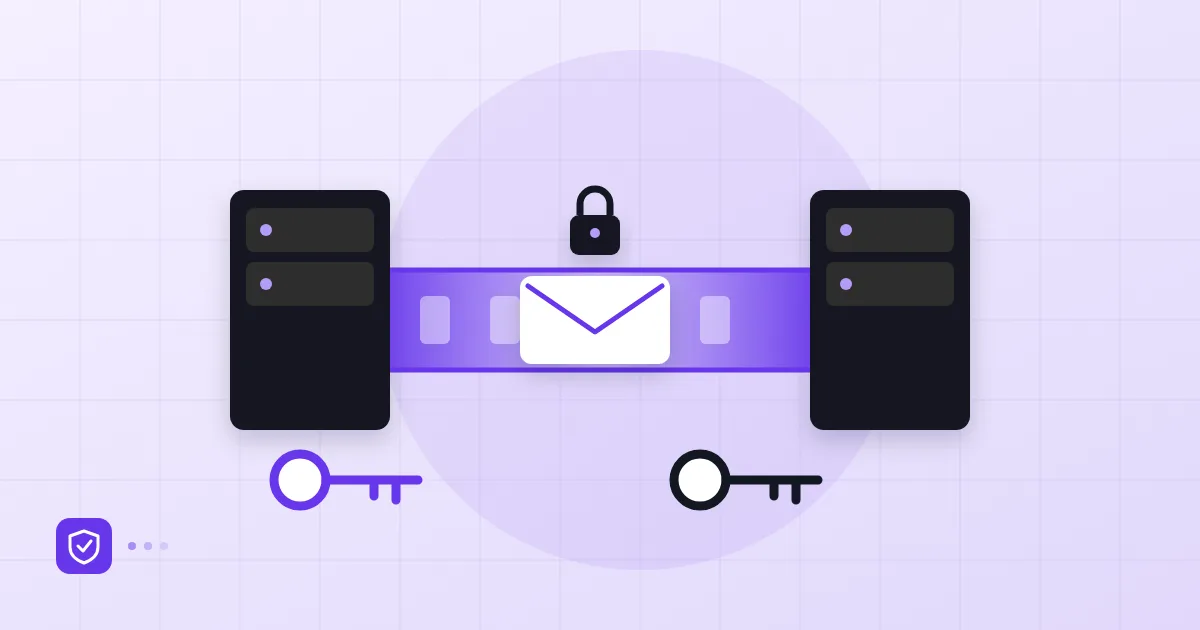
S/MIME and PGP encrypt the message itself, so nobody in the middle, including mail servers, can read it. Only the recipient's private key opens it.
| S/MIME | PGP | |
|---|---|---|
| Key source | Certificate issued by a certificate authority | Key pair generated by the user |
| Trust model | Centralised (CA) | Between individuals, keys verified manually |
| In companies | More common, broad client support | Technical users, journalists, developers |
| Difficulty | Certificate renewal and distribution | Key exchange and backup |
Who should use them? Law firms, healthcare providers, journalists and teams in sensitive negotiations come to mind. For general office chatter, invoices or customer questions it is usually overkill.
A note of honesty: S/MIME or PGP support is not something Postanex promises, and this article is general information. If end-to-end encryption is a hard requirement for you, evaluate client-side options separately and discuss the need with our support team before deciding.
Why end-to-end costs convenience
End-to-end encryption means the server cannot see the message, and a server cannot process what it cannot see.
The consequences are concrete. Webmail search does not work or works poorly. Spam and malware scanning is blind to encrypted attachments. Reading on your phone means moving the key to the phone too. A user who loses their key can never open old mail, because nobody can recover it. And if the other party does not use S/MIME or PGP, you cannot send them an encrypted message at all.
The pattern we see in practice: a team switches S/MIME on because of one contract, and a few months later people quietly give up because a certificate expired and nobody renewed it. Tie the need to a real threat; "it would be nice to have" is not enough. For the longer-term picture on cryptography and what comes after today's algorithms, read our note on post-quantum cryptography and email.
Enforcing TLS: MTA-STS
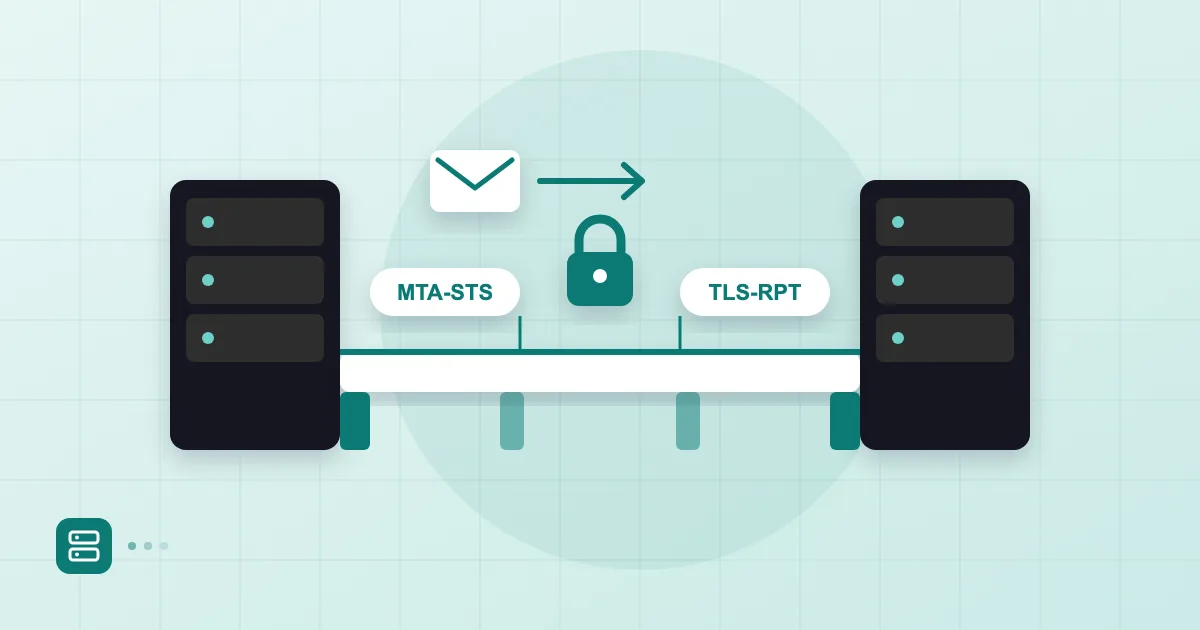
The weakness of opportunistic TLS is that an attacker can strip the encryption offer and force plain text, a downgrade attack. MTA-STS closes that gap: your domain tells senders to deliver only over TLS with a valid certificate.
It has two parts, a DNS TXT record and a policy file on a web server.
_mta-sts.example.com. IN TXT "v=STSv1; id=20261121T000000"
The policy file lives at https://mta-sts.example.com/.well-known/mta-sts.txt. Start with mode: testing, and once TLS-RPT reports look clean switch to enforce. Full steps are in our MTA-STS and TLS-RPT setup guide.
Practical recommendation
For a small company our order of priorities is this. Use TLS on every client connection and close any plain-text ports. Ask your email provider in writing where and how stored data is encrypted. Turn on MTA-STS in testing mode for your domain. Introduce S/MIME or PGP only where a specific person or contract requires it, voluntarily, never forced on everyone.
Encryption is only one piece of email security. If an account is hijacked, the attacker reads mail regardless of encryption, so the two-factor and password items in our small business email security checklist matter at least as much. Forged senders need their own defence, which we describe in email spoofing.
Frequently asked questions
Is email encrypted by default?
The connection is usually encrypted with TLS, but that is not guaranteed; if the other server does not support it, mail can travel in plain text. The message itself is not end-to-end encrypted.
What is the difference between TLS and S/MIME?
TLS protects the connection, and the message is readable once it reaches a server. S/MIME encrypts the message itself, and only the recipient's key can open it.
Does every company need S/MIME or PGP?
No. For most companies TLS, strong passwords and two-factor authentication deliver more value. End-to-end encryption makes sense when there is a specific, sensitive communication need.
What does MTA-STS do?
It tells sending servers to require encryption when delivering to you, which blocks downgrade attacks.
- email encryption
- TLS
- S/MIME
- PGP
- MTA-STS