If your company sends marketing email to people in Turkey, a purchased list and a footer link are not going to cut it. Turkish rules on commercial electronic messages put consent first, require it to be recorded, and give the recipient a simple way to take it back. We are an email infrastructure team, not lawyers, but we see the same questions from foreign senders again and again, so here is the plain-language version.
Short answer: To send marketing email to recipients in Turkey you generally need their prior consent, managed through a national registry called IYS (the Message Management System), and every recipient must be able to opt out at any time. Transactional messages such as invoices are treated differently, but the line needs care.
Commercial versus informational messages
A commercial electronic message is one sent to promote goods, services or a business. The core framework is Turkey's Law on the Regulation of Electronic Commerce and the regulation issued under it. What matters is the purpose and content of the message, not what you call it; "newsletter" and "announcement" do not change the analysis.
Here is how we separate the common cases. An order confirmation, shipping notice, invoice or password reset is a transactional message tied to something the recipient asked for. A campaign announcement, a discount newsletter or a "meet our new product" email is commercial. The grey zone appears when someone adds a "check out our new offer" block to the bottom of an invoice email. We advise against it. It turns a transactional message into a commercial one and invites the consent question. Keep transactional mail plain.
Consent and the role of IYS
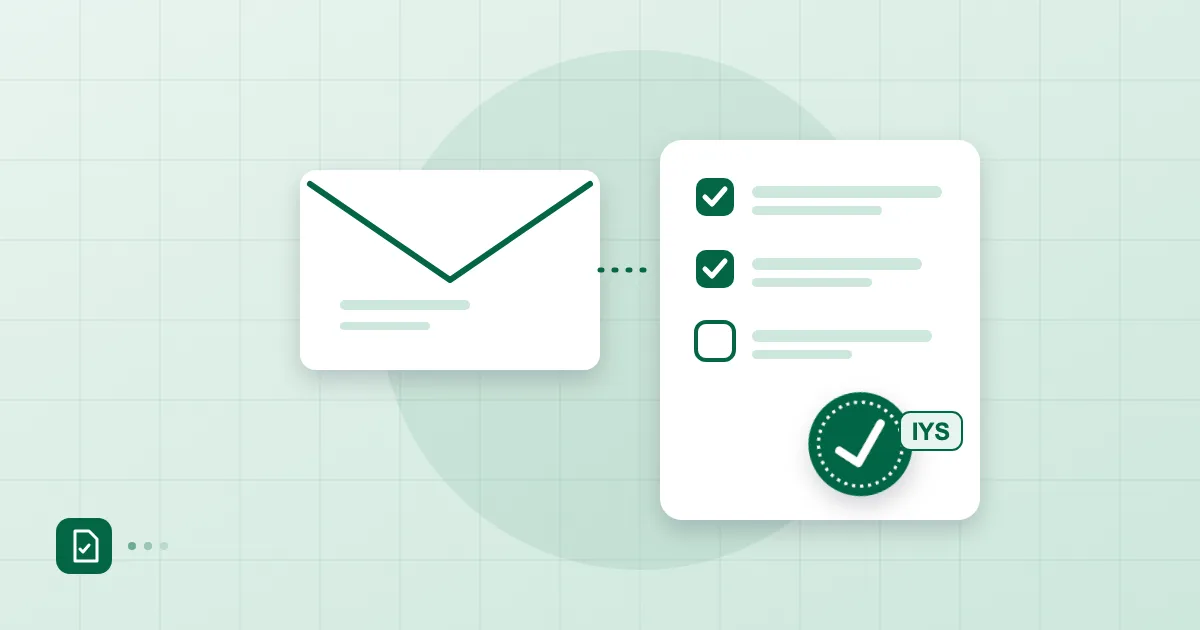
Consent means the recipient agreed in advance, by their own choice, to receive commercial messages from you. You need a record of it: when, through which channel and with what wording. IYS is the central system where these consents are held and where refusals are handled. For the official explanation and the current process, go to the IYS website; rules and technical procedures change over time, so trust that source over any blog, including ours.
A practical detail: the consent checkbox on your form should not be pre-ticked. A pre-ticked box makes it hard to argue that the recipient expressed a choice. The wording should also be clear, and "I want to hear about campaigns" should not be buried in the same box as "I accept the terms".
Decide who in your company owns consent, too. If marketing keeps one set of records and sales keeps another spreadsheet, an opt-out can easily be applied in one place and missed in the other. Build a single source of truth.
How long you must keep consent records is its own question. The regulation expects the service provider to retain consent records for a defined period; check the current text for the length and the starting point. Our advice to customers is to keep the records but manage them as personal data, which means applying the data-protection principle of keeping data only as long as needed. The two principles do not contradict each other; they simply require a retention schedule, which we cover in our email retention guide.
Opt-out and unsubscribe
Recipients can withdraw consent at any time without giving a reason. The regulation expects sending to stop within a short period after a refusal is received; at the time of writing that period is stated as three business days, and you should confirm the current text from the official source.
Every commercial message should carry an easy-to-find link that actually works. The typical mistakes we see are an unsubscribe link in tiny grey type, a page that demands a login before it lets you leave, and an unsubscribe button that records nothing. These are legal risks and deliverability problems at once: an annoyed recipient hits the spam button, and your reputation drops.
On the technical side, adding a List-Unsubscribe header to bulk mail is good practice, and major mailbox providers now expect it from bulk senders. We collect those expectations in our article on bulk sender requirements.
List hygiene
Clean lists serve consent and inbox placement at the same time. Importing an old customer list wholesale and mailing a newsletter means reaching people with no consent record and pushing up your bounce and complaint rates. Do not use a list that was bought or scraped; you cannot show that those recipients ever agreed.
We recommend a simple routine: store the consent date and source on each record, remove contacts who have not engaged for a long time, and process refusals and bounced addresses immediately. If you want to read bounce responses such as 550 or 5.7.1 properly, see our guide to bounce codes.
Link to authentication and deliverability
Having consent does not guarantee inbox delivery. A fully consented newsletter can still land in spam if SPF, DKIM and DMARC are missing. Legal compliance and technical compliance are two halves of the same problem. And if a third-party platform sends on your behalf, it needs to be authorised to sign for your domain, or receiving servers will treat the mail as forged.
Mind your sending reputation as well: mailing thousands of people on day one from a new domain causes trouble even when every recipient opted in. We explain how to ramp up in our piece on domain and IP reputation.
A ready-to-use checklist
This is not legal advice; it is a list of questions to ask before every send.
- Is the purpose of this message commercial, or is it transactional information the recipient requested?
- For every recipient, can I show when, through which channel and with what wording consent was given?
- Is the checkbox unticked by default and the wording clear?
- Does the message contain a working, easy-to-find unsubscribe link?
- When an opt-out arrives, do I have a process that stops sending quickly and updates the record?
- Are consent and refusal data in one place?
- Is my domain authenticated with SPF, DKIM and DMARC?
If you also handle recipients' data across borders, read our note on transferring data abroad under Turkish data-protection law. And should a mailbox compromise expose recipient data, the 72-hour breach notification guide explains the reporting clock.
This article is for general information only and is not legal advice.
Frequently asked questions
Do I need IYS consent to send an invoice by email?
Invoices and order notifications that are transactional may not count as commercial messages. If you add advertising or campaign content, the message can take on a commercial character. If the line is unclear, ask your legal counsel.
Can the consent checkbox be pre-ticked?
We advise against it. A pre-ticked box makes it harder to demonstrate a free choice by the recipient. Consent should be separate, clear and given through the recipient's own action.
How quickly must I stop emailing someone who opts out?
The regulation sets a short period after you receive the refusal. Verify the current period from the official source, and automate the process as much as you can.
I am a foreign company. Do these rules still matter for me?
If you send commercial messages to recipients in Turkey, they are relevant to you. Start with the IYS site for registration and integration details, and check whether your email marketing tool supports the process.
- IYS
- Turkey
- email marketing consent
- opt-out