An accountant sends a payroll sheet to the wrong company by accident. By the time she notices, the message is long gone. "Just one email," you might say. Under Turkey's Personal Data Protection Law (KVKK) it is an event that has to be assessed. The question we hear most about KVKK breach notification is simple: when does my clock start, and what do I tell whom? This article walks through typical email-related incidents, the 72-hour rule and what follows, in plain language.
A caveat first. We work on email infrastructure; we are not lawyers. What follows is a general frame. For your actual incident, confirm timing and procedure on the official KVKK site and work with legal counsel.
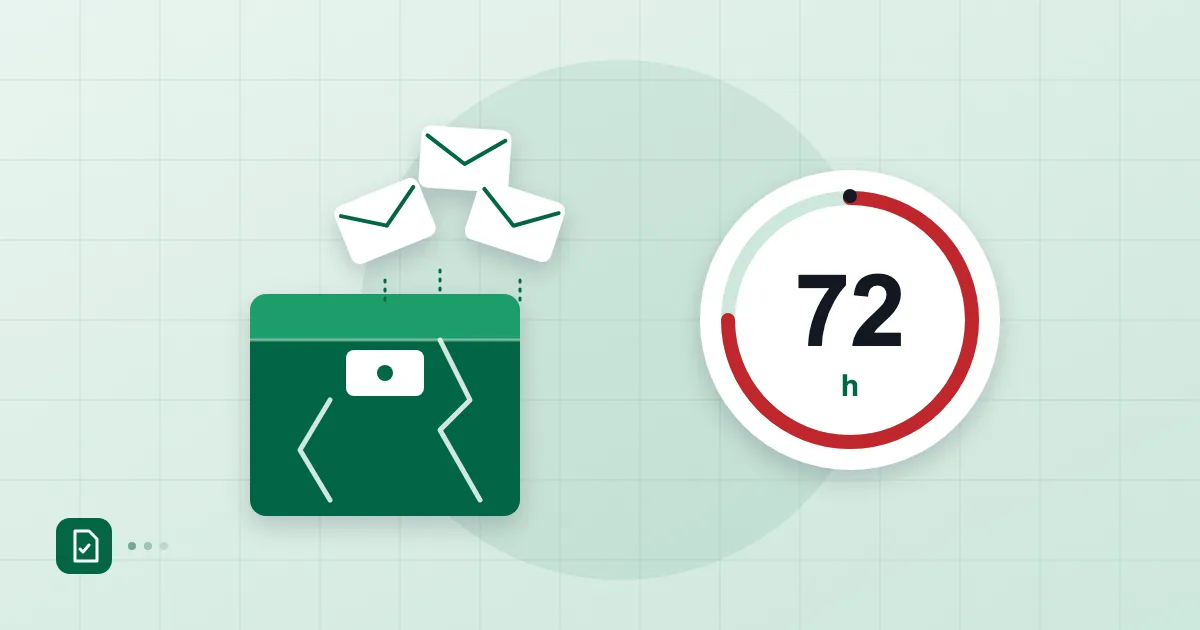
Short answer: Under the Turkish Personal Data Protection Board's decision no. 2019/10, a data controller must report a personal data breach to the Board within 72 hours of becoming aware of it. Affected individuals are told as soon as reasonably possible, and every incident goes into an internal record.
When does a data breach arise?
Article 12 of the KVKK law deals with the situation where processed personal data is obtained by others through unlawful means. The key idea is that the data was obtained by an unauthorised party. No hacker is required. An email sent to the wrong recipient can fall within this frame if it contained personal data.
Two practical questions help. First, did the message contain personal data: names, ID numbers, bank details, health information, CVs? Second, did that data reach, or might it have reached, someone who should not have it? If the answer to both is yes or "we are not sure", treat the event as a potential breach and record your assessment.
Typical email breach scenarios
We see three scenarios most often. The first is the wrong recipient: autocomplete picking the wrong contact, a bulk message where every address is visible in To instead of Bcc, the wrong file attached. The second is account takeover: a phished or leaked password gives someone else the mailbox, and the whole archive of past correspondence is in scope. The third is a lost or stolen device: an unencrypted laptop with a mail client left open.
Not every incident weighs the same. One recipient who deletes the message and confirms it is different from hundreds of people's data going to an open list, or a hijacked mailbox. To make that distinction you need to document the incident while it is fresh. For the first hours of a takeover, see our first 24 hours response plan.
The 72-hour rule and who is responsible
The law says "as soon as possible". The Board's decision of 24 January 2019, no. 2019/10, turns that into 72 hours counted from when the controller learns of the breach. The Board publishes the notification procedure on KVKK's official pages; for the current version, see the KVKK breach notification page.
Three points deserve to be kept clear. The clock starts when the controller becomes aware, not when the breach happened. If complete information cannot be gathered inside the window, the Board's approach allows information to be provided in stages along with an explanation for any delay, so "let us wait until we know everything" is not a good strategy. And the notifier is the data controller. If you buy email service from a provider, that provider is usually a data processor and is expected to inform you without delay, but the notification to the Board is still your responsibility. If your provider is abroad there is an additional dimension, which we cover in KVKK cross-border email data transfers.
What does a notification contain?
The Board provides a notification form and expects you to complete it through its official channels. In general it asks when and how the breach was discovered, which groups of people are affected and roughly how many, the categories of data involved, likely consequences, measures taken and planned, and a contact person. Download the form and the full field list from the official site; our summary may be incomplete.
A side benefit: the questions on the form largely overlap with the internal document you should prepare after an email incident anyway. A one-page note written at the moment of the breach tends to become the draft of the notification.
Notifying the people affected
Telling affected people is a separate step from notifying the Board. The Board expects it to be done in clear, plain language, setting out the likely consequences and the measures taken, and with timing tied to an "as soon as possible" standard. For email incidents this is usually done directly by email or phone. A few lines without jargon, saying what happened and what they should do, work well. Concrete advice, such as changing a password or watching for suspicious messages, is good practice.
Internal records and prevention
Whether or not notification is required, every breach or suspected breach should go into an internal record: the event, date, those affected, measures taken, the decision on notification and the reasoning. That record is your answer to the later question "why did you not report it?". For general thinking about how long records and mail are kept, see our piece on email retention periods.
On prevention, practical email steps include turning off autocomplete for sensitive sends, a Bcc habit or a separate tool for bulk mailings, password-protecting attachments that carry personal data and sending the password through another channel, enforced two-factor authentication and domain security. Using a service that stores data in Turkey reduces cross-border transfer questions; we discuss that in email that keeps data in Turkey. If you also deal with the EU, GDPR and NIS2 have their own reporting clocks; our article on NIS2 and GDPR for Turkish companies covers that side.
This article is general information, not legal advice.
Frequently asked questions
Is sending an email to the wrong recipient always a data breach?
No. If it contained personal data and an unauthorised person accessed it, it may be. The effect, the type of data and the recipient's situation change the assessment. Record the incident and decide with legal counsel whether notification is needed.
When does the 72-hour clock start?
Under the Board's decision 2019/10 it runs from the moment the data controller becomes aware of the breach. Write down when you noticed it and who noticed it.
Does my email provider make the notification?
Usually not. The provider, acting as a data processor, informs you of the breach; the data controller notifies the Board. Check your contract for any clause on how quickly your provider must tell you.
Should I record breaches that do not need notification?
Yes. A record with reasons is the most practical way to defend a decision later.
- KVKK
- data breach
- 72 hours
- personal data
- email security