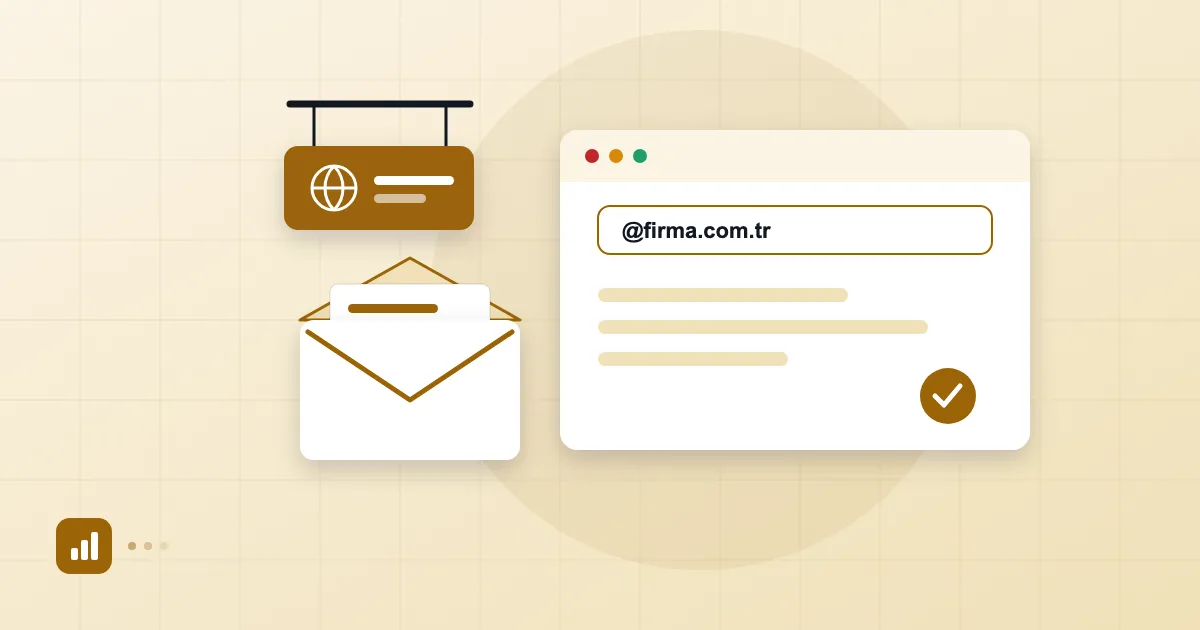
You type your website's domain a few times a year. You type, spell out and say your email domain dozens of times a day: on the phone, in meetings, on business cards. That is why picking a domain name for email deserves more attention than picking one for a brochure site.
This article looks at the extension, length and typing risk, the registrar, and expiry. We also cover what you can change after choosing and what you cannot.
Short answer: If most of your customers are in Turkey, .com.tr and .tr signal local trust; if you sell abroad, .com is more familiar. The most important thing is a short name that is easy to say and hard to confuse. Once an address has been handed out, changing it is expensive, so spend your time on the name rather than the extension, and register the domain in your own company's name.
A domain is your email identity
In ayse@example.com.tr, everything after the @ tells people who you are. It appears next to the sender name in the inbox, and most people glance at it to decide whether to trust the message. A personal webmail address next to your own domain is like a handwritten note next to a printed business card.
Once a domain is in use, everything attaches to it: cards, invoices, suppliers' address books, your presence in search results. Changing it is possible, but it means changing all of that. If you are starting fresh, setting up business email with your own domain lists the steps in order.
Extension choice: trust and audience
Asked which extension is best, our answer is that it depends on the audience.
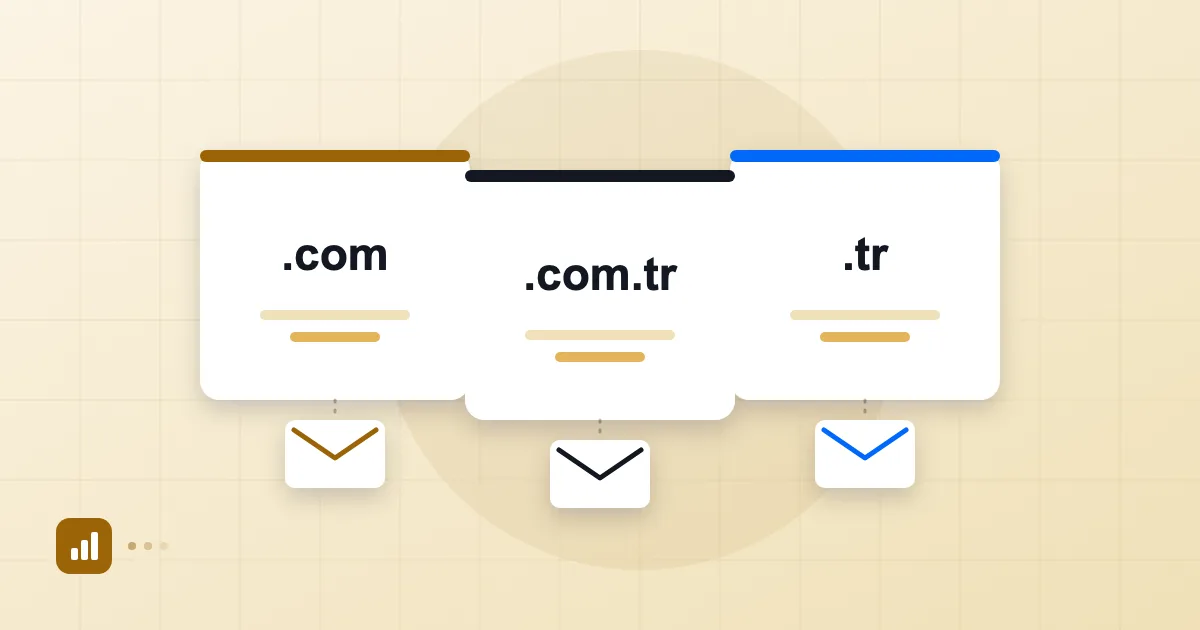
| Extension | When it makes sense | Watch out for |
|---|---|---|
| .com | Sales abroad, an international brand | Your preferred name is probably taken |
| .com.tr | Companies in Turkey, local customers | Less recognised outside Turkey |
| .tr | A short, modern look with local identity | Some customers still expect .com.tr |
Registration of .com.tr names generally involves verifying company or identity documents; ask your registrar about the process and the current rules. Direct .tr registration is also available, but conditions and prices vary by registrar, so we will not quote them here.
There is a third option: buy two and use one as primary while the other redirects and blocks lookalikes. A small business does not need it. A business with international customers may find it sensible.
Short, typeable, speakable
How many times have you said "hyphen or underscore?" to a customer on the phone? We recommend avoiding hyphens, digits and accented or non-Latin characters in an email domain. Internationalised domains are technically possible, but they still cause trouble in email, and some systems refuse them.
A simple test: read the address aloud once and see whether the listener can write it correctly. If they cannot, it is too long or too clever. A short, distinctive name beats a pile of generic words like "solutions" and "services". A mistake we see often is keeping the domain as long as the company name, when the two do not have to match exactly.
Typos and lookalikes
Think about the errors someone will make writing your domain down. If ö, ü or ı will be typed as o, u or i, is that version taken too? It matters for two reasons: mail meant for you may reach someone else, and impersonation. Someone can register exarnple.com.tr, where "rn" passes for "m", and write to your customers pretending to be you.
You do not need to buy every variant. The likeliest misspelling and the .com twin are cheap insurance. On the technical side, publishing SPF and DMARC the way we show in creating a DMARC record makes it harder to send fake mail from your real domain, though it cannot stop lookalike domains.
How the address looks in your signature is part of this choice too; our guide to writing a professional email signature helps.
Registrar and ownership rights
Where you buy the domain and where you host the mail are independent. The domain can sit at Natro, İsimtescil or GoDaddy while mail runs somewhere else entirely. DNS records, above all the MX record, connect the two; we explain that in what an MX record is. With Postanex, the domain stays at your registrar and only a few DNS records are added.
In practice, you can change email provider without moving the domain. But who owns the domain is critical. Our standing warning: do not register it under your web agency's account, a former employee, or a developer's personal login. Getting a domain back after a dispute can take months. The registrant should be your company, and the admin contact should not be an address belonging to someone who no longer works there.
Renewal and expiry risk
Domains renew yearly or are bought for several years. When one expires and the registrar's grace period ends, it stops working, and so does the mail. The worst part is that nobody usually notices: the reminder goes to an old address used at registration.
Turn on auto-renew, keep the contact address current, put the renewal date in a calendar, and pay a few years ahead if you can. A domain is cheap; losing one is expensive. To see how domains fit into the total cost, our business email pricing guide shows the method; the domain is a small line you should not skip.
If you are deciding between a free webmail address and your own domain, Gmail versus business email will help.
Frequently asked questions
Is .com.tr or .com better for email?
If most of your customers are in Turkey, .com.tr gives trust and local identity. If you sell abroad, .com is more familiar. You can also register both and redirect one to the other.
Where should I buy a domain for email?
Any registrar works, because email hosting is independent of where the domain is registered. What matters is that your company is the registrant and renewal reminders go to a current address.
Are non-Latin or accented domain names suitable for email?
We do not recommend them. They are technically possible, but some systems handle such addresses poorly and people struggle to type them.
Can I change my domain later?
Yes, but you will need to forward mail from the old address and tell everyone. Choosing carefully the first time is far easier.
- domain name for email
- domain extension
- .com.tr
- business email